Wednesday, 26 October 2011

Ghoulies, ghosties and long-leggety beasties

As night-time falls the creeping, slithering, stalking world arises, lit only by a pale-faced moon.

From ghoulies and ghosties, long-leggedy beasties and things that go bump in the night, Halloween can be a lot of fun.

And, certain animals, including black cats and blood-sucking vampire bats, are perfect for evoking a sense of fear around this time of year.

Black cats have been the subject of much debate, fear and superstition for centuries. Depending on the part of the world you live in, or the time in history in which you lived, they could be associated with witches, anarchy, evil, demons, illness, prosperity, luck or even a storm at sea.

Today, superstitions about these cats still remain. This may be the reason why many animal charities – including the RSPCA and Cats Protection – report difficulties in rehoming black cats. In fact an RSPCA centre in Shropshire has designated October 'Black Cat Awareness Month' in a bid to rehome unwanted felines.

One such example of a beautiful black cat that keeps being overlooked is Trixie. This gorgeous two year-old girl has been through a lot in her short life.

Trixie was left totally bald on her back legs, and had to have her tail amputated after she was injured by a small child who had got hold of a pair of hair-straighteners. Sadly it is not unusual for RSPCA staff to see animals come into our care with horrific injuries caused either by accident, neglect or mistreatment.
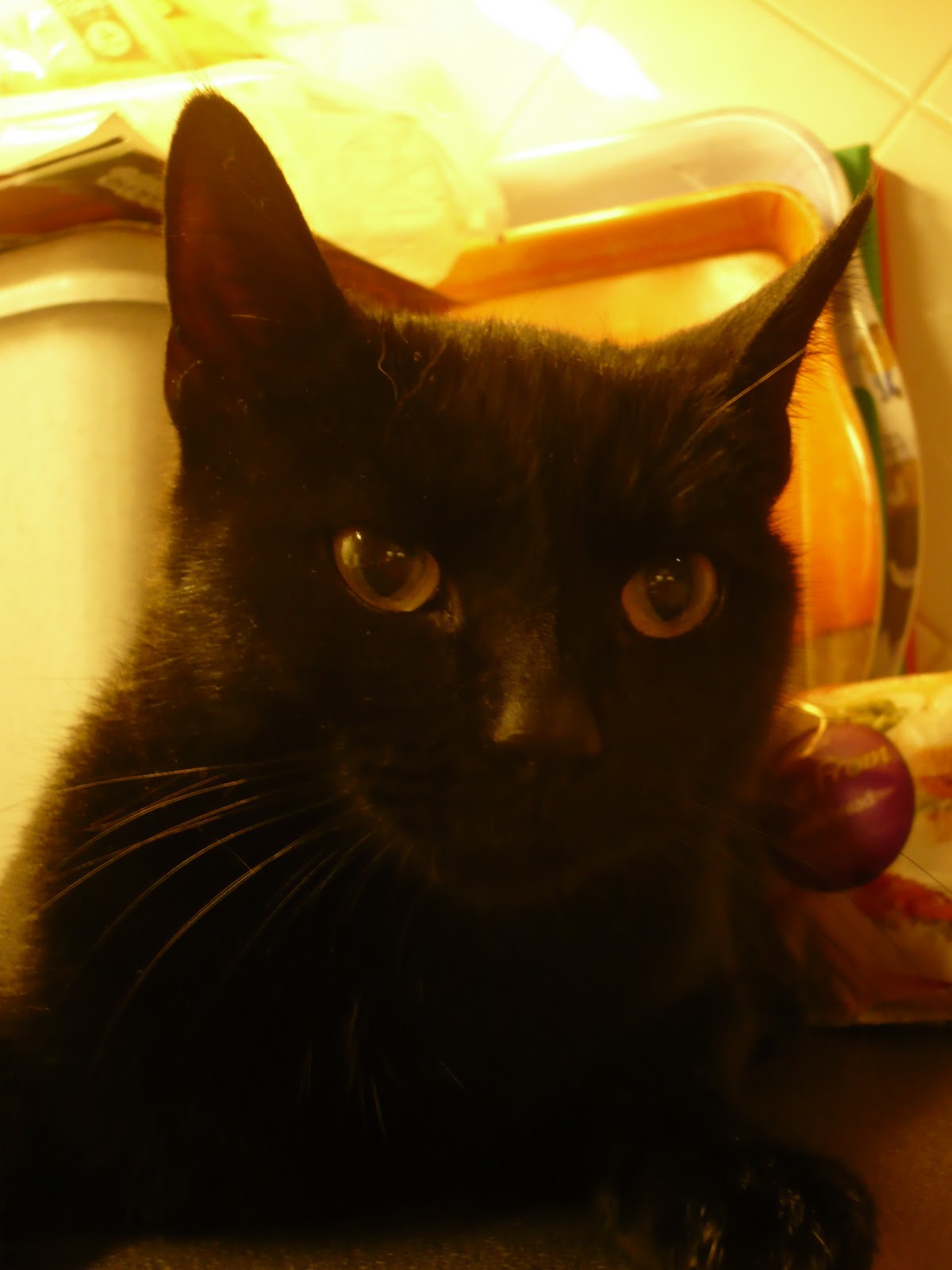
Trixie is currently being looked after by a foster carer (another group of unsung heroes without whom the RSPCA couldn't continue to care for the thousands of animals it does), and they tell me that she is a lovely, affectionate and very placid cat - despite what she has been through.

Apparently she is fine with other cats, and even though her fur may never grow back, with lots of TLC she will grow in confidence and become a loyal companion for someone.

Not just that, but in the spirit of Halloween, Trixie has white marks on her sides - which means she is also rocking a rather fabulous Mortica Addams look!

If you are interested in giving Trixie a new home, please contact Lisa at RSPCA Northamptonshire on 07840 926122. To see other cats looking for good new owners, why not visit our rehoming pages on the website and brighten up a black cat's day?

Cat facts:
• In Florida, USA, some shelters halt black cat adoptions at this year. They say many people will adopt black cats simply for Halloween decorations, not because they want to provide a home to a new pet. Palm Beach also bans adoptions on Friday the 13th.

• It was once believed that a fisherman’s wife can protect her husband from dangers at sea by keeping a black cat

Few things are more chilling that the thought of a night creature that subsists on the living blood of another organism. Perhaps that’s why bats have lived in our haunted imaginations for thousands of years.

Even before Bram Stoker's book, Dracula, fear of blood-sucking animals was common, and many cultures from different periods have their own version of the story. However, a real bat is much more innocuous. Most subsist on insects. Of the hundreds of species of bats, only three actually drink blood - and only one drinks blood from mammals.

In fact, the RSPCA does a lot of rescue and rehabilitation work with bats – at all times of the year, not just Halloween!

A bat expert at our Stapeley Grange Wildlife centre has discovered a new way rehabilitating injured bats, and back in June we cared for 47 baby bats which were illegally removed from their roost, leaving them without a mother.

The pipistrelle babies were discovered in the box in Wiltshire by a member of the public along with two adult females, one with a fractured wing.

The baby bats, some "no bigger than a thumbnail", were all infested with mites and suffering from dehydration. The orphan pipistrelles are currently being hand-reared, round the clock, by a team of six "bat workers".

So that’s it for today’s blog. Just remember - most of the time we make up scary stories about certain animals just to entertain ourselves...but of course, that doesn't mean they're not lurking, just outside your window...

Bat Facts:

• Vampire bats adopt orphans, and are one of the few mammals known to risk their own lives to share food with less fortunate roost-mates.

• An anticoagulant from vampire bat saliva may soon be used to treat human heart patients and stroke victims.

Calie Rydings, RSPCA press officer

Monday, 17 October 2011

Cash-strapped shoppers want a bargain but also have values

I was surprised and pleased to learn that, despite difficult financial times, almost half of shoppers still say that the welfare of animals is extremely or very important when it comes to choosing their groceries.


The future also looks positive, with nearly a third of shoppers saying they expect to purchase more free range and high animal welfare products in the year ahead*.

The figures should be higher, of course, but it is an encouraging figure; although people want a bargain, many are also maintaining their values.

This trend is clearly having an effect on businesses, an increasing number of whom are trying to improve on animal welfare.

I recently helped out at the RSPCA Good Business Awards ceremony, where companies who are already going the extra mile for animals were recognised for their efforts. It’s great to see that some companies are recognising their responsibilities and responding to what consumers want.

The winning companies were clearly very pleased to be recognised by the RSPCA, and will hopefully be encouraged to do even more.

You can find out more about ‘good business’ by watching this film (click on the image below of Farmer Brown in his tractor)  which was shown for the first time at the awards ceremony.

Also, take a look at RSPCA Freedom Food’s new Hettie the Hen animation about welfare-friendly shopping (click on the image at the end of this post)!

The winners of the RSPCA Good Business Awards 2011  are……

For the third year running, Co-operative won the most public votes in the People’s Choice award, plus the award for Most Progress. Marks & Spencer received an award for Sustained Excellence, and Sainsbury’s picked up the prize for Excellence in Consumer Communications for its promotion of higher welfare food.

Riverford Organic (farms in Devon, Hampshire, Cambridgeshire and Yorkshire, delivers around the UK) won the Independent Retailer award, while Daylesford Farmshop (Kingham, Gloucestershire) and Edge and Son (New Ferry, Wirral) were highly commended.

Lussmans Fish and Grill Restaurants (St Albans, Hertford, and Bishop’s Stortford, Hertfordshire) won the Independent Restaurant award, while Due South (Brighton) was highly commended.

The Feathers Inn (Hedley on the Hill, Northumberland) won the Pubs category for its commitment to animal welfare, including a food festival and expansion into catering. This is the second time they have won this award. Catering company Eco Cuisine was highly commended.


Both large and small fashion companies are also working hard to improve animal welfare.

High street favourite George at Asda was presented with the Large Company award for its work on traceability, while Beyond Skin scooped the Small Company award for producing desirable, ethical high fashion footwear at an achievable price.

Rapanui was given the Innovation award for its use of QR codes (a type of bar code) on product labels. Customers can scan the tag using a smart phone to view interactive information about the origins of the raw materials in the garment. The judges described the idea as ‘game changing’.

The Best Newcomer award was won by The North Circular and Frank and Faith were highly commended in the Small Company category.

*Source: IGD


Helen Coen, senior RSPCA press officer

Thursday, 6 October 2011

It’s a Strangelove...or how I stopped worrying and learnt to love my dog

Have you seen the film 'Marley and Me?' - you know the one about the family who learn important life lessons from their adorable, but naughty labrador...who is often described as 'the world's worst dog'?

Well, I've got news for you film fans...Marley is a perfect pooch compared to my dog, Mister Bones.

We got Mister Bones during the long hot summer of 2008. My husband and I carried him home, wrapped in a blanket, feeling for all the world like proud new parents.

We had got his dog bowl, bed and toys all ready. We had read the books and done our research, so we felt we were ready to raise this beautiful (if slightly daft looking) animal.

Ten hours later...our sofa was ripped to pieces, his toys lay in tatters, he had gone to the toilet all over the floor and was now crying into the night because we wouldn't let him in our bed.

The truth is that everybody who gets a new puppy expects a few nights, maybe even months of this sort of thing right? Well, here we are four years later, and while Bones is now (mercifully) house-trained, he is still the naughtiest dog I have ever met!

We have another dog – Scarlett – a beautiful old rescue dog who came to us from a terrible, cruel home. When we got her she was very underweight despite being a greyhound cross, had never been house-trained (or indeed slept inside a house), or had a proper collar. She was bald around her neck from where she had been tied up and covered in scars.

It took a few weeks and a lot of patience but soon we saw Scarlett grow in confidence and she became a keen student, eager to learn sit and stay, fetch and play. She is – most of the time at least – the perfect dog!

But Bones is special. Despite puppy classes and training groups he has struggled to learn anything other than sit. He does come back on walkies, but only if there is food to tempt him. He sometimes plunges himself into rivers, forgetting he is afraid of water and then cries for us to come and pluck him out. I have on many occasions seen him run straight into the glass balcony door because he forgets it’s there...and so it goes on.

Even our animal-loving friends and family refused to dog-sit Mister Bones because of his tendency to emit a high pitched whine (that we call his sorrowful song) whenever he wanted attention.

We had begun to despair – fearing we were terrible owners. Then I had a baby and suddenly Mister Bones grew up. Far from being jealous of our son, as we had feared, Bones loved him!

Although our boy is now an energy-filled bundle of toddlerhood, Bones is gentle and patient with him. In fact, he adores him...especially at dinner times, when he sits ever so attentively by his highchair waiting for the inevitable scraps to be flung his way.

The point that I am making is that dog ownership is never straightforward – it is fraught with challenges and especially when you bring a new person or animal into the house it can be a very worrying time.

The most important thing I have learnt living with Bones is that you as an owner have to be willing to understand and recognise what your dog is feeling.

Be gentle and patient, try to let the little things go but remain focused on the important skills you can teach your dog that will help them live a happy, fulfilled life.

Living with Bones has been a rollercoaster. He has cost us thousands of pounds in damage (1xcomputer, 1xsofa, 1x family Christmas presents, 50+ books/ DVD’s destroyed and the list goes on) but to us – he is priceless.

Calie Rydings, RSPCA press officer

Monday, 26 September 2011

Give some chirpy chooks a good home

My partner and I have decided to get four new chooks after our previous brood died last year. We did have just three hens – Geraldine, Lillian and Gillian - all named after good friends we’d made in a Ugandan village.

They were ex-battery farm birds, and even I hadn’t been quite prepared for their terrible appearance when we collected them. Pecked, de-feathered and defeated, they seemed a sorry sight.

The utter cruelty of battery farms should have been consigned to history long ago, and next year’s ban on battery farms across Europe can’t come soon enough. But it’s extremely frustrating to know that the so-called ‘enriched’ cages meant to replace the old ones are a pretty small change. A cage is a cage is a cage.

So what can we do? Well, we’re one of thousands, if not tens of thousands, of people who’ve decided to keep their own chickens. They make such great companions, I’m just surprised more people don’t do it.

Ok, there’s a bit of hen-house clearing out, some scratching of the lawn, and the occasional wiping of a hen’s bum.

But there’s the joy of watching an ex-battery hen which has never seen earth before instinctively start to shimmy and bathe contentedly in the dust. You also get to see a bird, initially so bald that it looks like it’s come from a supermarket shelf, return to full-feathered splendour.

And of course there’s the never-ending supply of eggs, great for neighbourly diplomacy, and which you also know have come from happy and healthy animals. It means you can always ‘go to work on an egg’ – not to mention the child-like joy of discovering a freshly-laid warm egg, especially comforting on a cold autumnal morning.

As before, our ten-year-old cat Margot will no doubt be more than a bit curious about the flappy new friends sharing the garden, but she’ll take it in her stride. After a few days of wary circling, detente is quickly established and all the animals go about their business without any fuss.

With our last brood, there was even a hint of friendship – one day we came home to find hen and cat lying down in the grass beside each other and enjoying the sunshine together.

The joy of hens. We’d recommend it to anyone.

So go on, give some chirpy chooks a good home.

Henry Macaulay, RSPCA head of press

Thursday, 15 September 2011

Cats and other tails from the regions

It’s all bits and pieces from me this week, starting with the change of profile pic to my dog Xabi who is sporting her new haircut for autumn!*


One of the big problems facing RSPCA branches and centres every summer is the deluge of unwanted cats and kittens which fill every space in catteries and in foster homes.


Now we are seeing this year round and, as more cats are abandoned, less people come forward to give them homes. 10,610 were reported as abandoned 2010, compared to 8,310 in 2009.


If I could ask for one thing it would be to urge people to get their cats neutered or spayed – many RSPCA branches and other organisations run discounted programmes for those who might struggle to afford it. It really is the kindest thing to do and helps prevent the heartbreaking situation of cats and kittens being dumped.


One kitten this week was found tied to a dog crate with an old piece of bailing twine in Chesterfield, Derbyshire. Just a few days later, two tiny newborn kittens were dumped in a soaking wet cardboard box in Sunderland. Luckily, all three were found before any serious harm could come to them but it could easily have been a different story.


The big story of the last week was the rescue of more than 400 Manx shearwaters which had blown off course in strong winds as they migrated to Argentina. The shearwaters were leaving the islands of Skomer and Skokholm off the coast of Pembrokeshire, which are home the largest known concentration of the birds in the world, when they ended up being stranded in the surf on the Welsh mainland.


The RSPCA rescued the birds and transferred them to its West Hatch Wildlife Centre in Taunton, Somerset to be rehydrated and fed so that they would be strong enough to survive their migration. They are now being released in groups of around 30 at twilight (as they are drawn towards daylight and may veer inland) off the south coast so they can continue their journey to South America.


In other news, we have been recognising those who have done outstanding work in the field of animal welfare in our 2nd annual RSPCA Honours ceremony, which was this year hosted by our vice president, actor and presenter, Brian Blessed.


The awards were given to some of our own inspectors for their exceptional hard work in many areas, as well as to individuals like Jill Robinson from Animals Asia for her incredibly effective efforts to end the cruel practice of farming bears for their bile, and to Danny Penman, a journalist who has covered countless exposes of animal cruelty, such as Canadian seal hunts and the shipment of monkeys in Asia to European laboratories, to the public’s attention through his tireless undercover work.


And, finally we’d like to say a big thanks to Simon Pegg. The Shaun of the Dead and Run Fatboy Run star popped into an RSPCA charity shop in Crouch End, London, to donate a bundle of clothes. The clothes included a Versace suit and the money raised will go towards helping the thousands of animals cared for, treated and neutered by the Central and North London branch of the RSPCA.


*Xabi was rehomed from RSPCA Block Fen in Cambridgeshire six years ago. She doesn’t shed hair so needs regular grooming as she gets very furry, hot and uncomfortable, especially now she’s getting older!

by Sophie Wilkinson, Regional Media Manager

Wednesday, 7 September 2011

The RSPCA's best-kept secret

I think one of the best kept secrets about the RSPCA is that we give a much-needed second chance to hundreds of horses and ponies each year.

Our work doesn’t finish when we’ve rescued them from cruelty or neglect and nursed them back to health. That’s only the start.

Each horse is assigned their own groom so they build a relationship with one person, and hopefully begin to learn that people are there to look after them, not harm them.

Grooms spend endless hours with horses to help them regain trust in humans after, in many cases, traumatic experiences.

Only when they are responding well to human contact does the next stage of their training start, and they practice having their feet picked up, being groomed and being led in hand.

Once they’ve mastered basic stable manners, they are trained to be ridden. This is done in a gentle and gradual way by introducing new experiences and building up the horse’s confidence, slowly working towards the time when they are happy to wear a saddle and bridle and carry a rider.

This preparation also increases the RSPCA’s chances of finding horses a good new home – especially in difficult financial times when fewer people can afford to take them on – as most people want a well-trained ‘ready-made’ horse that they are able to ride safely.

All of this costs money, of course, and it costs at least £5,000 to care for, rehabilitate and find a new home for each horse – only possible thanks to generous donations from the RSPCA’s much-valued supporters.

One of the most inspiring stories I’ve ever followed has been that of Polly, one of the many horses who have benefitted from the RSPCA’s hard work and expertise.

If you’re a member or a supporter of the RSPCA you may already have read her story in Animal life magazine. If you missed it, you can read her rags to riches tale here.

You can also listen to a podcast including interviews with some of the wonderful staff – all of them unsung heroes - at the RSPCA’s Felledge Equine centre who cared for and rehabilitated her, and watch a slideshow of photos of Polly.

I was lucky enough to spend time at the equine centre and watch the grooms working with horses at various stages of their training.

I was struck by the incredibly caring, nurturing environment and the obvious trust the team there had in each other and were gradually building with the horses in their care.

Polly was already in her new home when I visited, and Lisa Paulin, deputy manager of Felledge Animal Centre, was kind enough to take me to see her and meet her owner Krissy Bowden. 

Having seen the shocking pictures of Polly when she was first rescued, it was amazing to see her looking so happy and well.

I feel privileged to have met Polly and the wonderful people who have collectively, through a team effort, transformed her life.

To find out more about adopting a horse or pony from the RSPCA, please visit the RSPCA website.

Helen Coen, RSPCA senior press officer.


Friday, 2 September 2011

Nine hundred million reasons to support farm animal welfare

The alleys near the docks were dark, dank, and foul. Robbers lay in wait for sailors stepping ashore from their ships after months, even years, at sea.

Stray cats slithered and mangy dogs prowled. On the wet slippery roads wretched, beaten horses strained and slipped as they tried to pull their loads up the steep hills. Cattle were beaten in the street. This was London, 1824.

In St. Martin's Lane (not far from Piccadilly Circus) stood Old Slaughter's Coffee House. On the evening of June 16 1824, it was busier than usual - because a meeting had been called to discuss ways of protecting animals from cruelty.

Two years previously an Irish member of Parliament, Richard (Humanity Dick) Martin, piloted a Bill through the House of Commons called An Act to prevent the cruel and improper Treatment of Cattle, which made it an offence, punishable by fines up to five pounds or two months imprisonment, to "beat, abuse, or ill-treat any mule, ass, ox, cow, heifer, steer, sheep or other cattle."

But the Act (known as Martin's Act) needed men of vision and courage to ensure the clauses of the bill were put into effect. And one man determined to see that happen - the Reverend Arthur Broome had decided that if he could persuade a few prominent people to support him, he could found a society and employ an inspector to see that Martin's Act was properly enforced.

Humanity Dick himself was at the meeting, as well as a quiet man with a great social conscience called William Wilberforce - the politician who in the 1820’s led the movement to abolish the slave trade.

So, out of this historic assembly the SPCA was born – the world’s first animal welfare charity (The "Royal" was added later). On that night the SPCA declared they would send men to inspect Smithfield Market, where livestock had been sold since the 10th century, as well as slaughterhouses, in order to try and prevent the suffering of farm animals.

What I am trying to demonstrate is that while many people think of the RSPCA as a 'cats and dogs' charity, in fact the Society was founded in 1824 in direct response to witnessing cruelty towards livestock.

Now, nearly 190 years later – through the work of our farm animal science department and the higher welfare food and farming campaigns team - the RSPCA is very much honouring its roots; carrying out this vital work and striving for better welfare standards for all farm animals.

How do we do this? Well, by demonstrating, just as Martin and Wilberforce demonstrated, that improving farm animal welfare begins with the greatest ideas and the smallest actions.

I have worked as the RSPCA press officer for farm animals for three years and am proud of the work these guys do – largely behind the scenes. These are knowledgeable, passionate but pragmatic people, who care very deeply.

That said, it is a huge challenge to try to improve the welfare of such a large number of animals, from chickens kept as pets to pigs and cows on large-scale farms. That’s why we work in a number of different ways to encourage improvements, and always use all available science and practical evidence.

And how can you help? Well it’s easy really...buying just one item of higher welfare food a week, telling just one friend why supporting Freedom Food or Free range can help animals live better lives; or writing just one letter to a supermarket or an MP can help us improve the lives of the 900 million animals farmed in the UK each year.

To find out more about our work and what you can do help improve the lives of farm animals, go to: http://www.rspca.org.uk/allaboutanimals/farm

Calie Rydings, RSPCA press officer